
Extreme cold causes digital screens to fail, batteries to drain, and zippers to jam—making reliable gear selection critical for backcountry snowboarders. Cold-resistant analog watches, particularly zipper-pull designs like those from Dakota, offer a dependable alternative to digital devices when temperatures drop below zero.
Backcountry snowboarding is one of the most exhilarating pursuits on the planet. Untracked powder, no lift lines, nothing but open mountain terrain and the sound of your board cutting through fresh snow. But strip away the romance, and you're left with a hard truth: the backcountry is unforgiving, and the gear you bring can be the difference between a great story and a dangerous one.
Cold weather doesn't just affect your body—it attacks your equipment. The same sub-zero temperatures that make fresh powder so appealing also cause your digital devices to freeze up, your batteries to die without warning, and your fingers to become too numb to operate even basic controls. Most snowboarders focus on layering systems and avalanche safety equipment, but one frequently overlooked piece of backcountry winter safety gear is the humble wristwatch.
Knowing the time isn't just a convenience in avalanche country—it's a safety essential. Rescue windows, weather patterns, and daylight hours are all time-sensitive variables. A watch that fails when you need it most isn't a minor inconvenience. It's a liability.
This guide breaks down how extreme cold affects your electronics, why digital watches struggle in sub-zero conditions, what to look for in a glove-friendly watch for snowboarders, and why cold-resistant analog models—specifically from Dakota—are earning a reputation as the best watch for extreme cold weather sports.
How Extreme Cold Weather Destroys Electronics and Backcountry Snowboard Gear
Before focusing on watches specifically, it helps to understand the broader problem. Cold weather and electronics are fundamentally incompatible, and the backcountry amplifies every weakness.
Lithium-ion batteries—used in virtually every modern device—lose capacity rapidly as temperatures fall. At 0°F (-18°C), a fully charged lithium-ion battery can lose up to 20% of its capacity. At -4°F (-20°C), performance can drop by more than 40%, according to research from Battery University. Below -22°F (-30°C), some batteries stop functioning altogether.
LCD and touchscreen displays fare no worse. Liquid crystal displays rely on a fluid substance that becomes viscous in the cold, causing the screen to respond sluggishly, lose contrast, or go completely dark. Touchscreens, already tricky to operate with gloves, become unresponsive as the conductive layer stiffens.
Then there's moisture. Temperature fluctuations between the warm interior of your pack and the frigid mountain air create condensation inside electronics, accelerating corrosion and short-circuit risk. Add physical impacts from falls, and you have a perfect storm of failure modes that every backcountry rider needs to plan around.
Why Digital Watches Fail in Sub-Zero Temperatures
The failure rate of digital screens in sub-zero temperatures is higher than most riders expect—and the consequences in the backcountry are uniquely severe.
Most consumer-grade digital watches use LCD screens, which are susceptible to the same cold-weather degradation as phone screens and GPS displays. At temperatures below -4°F (-20°C), many standard LCD displays begin to slow their refresh rate noticeably. Below -22°F (-30°C), the liquid crystals can freeze entirely, rendering the display unreadable.
Beyond the screen itself, digital watches also rely on batteries and electronic components that are sensitive to thermal stress. Rapid temperature changes—like moving from a warm car to an exposed ridge—cause expansion and contraction inside the casing, which can loosen solder joints and damage internal circuitry over time.
For backcountry snowboarders specifically, there's another layer of complexity: most digital watches require fine motor control to operate. Small buttons, touchscreens, and complex menu navigation are designed for warm, dexterous fingers—not hands wrapped in thick gloves during a high-alpine descent. The risk isn't just that the watch fails electronically; it's that you simply cannot use it when you need it most.
What temperature range should a watch for snowboarders handle?
A watch designed for backcountry snowboarding and extreme cold weather sports should reliably operate at temperatures ranging from -22°F (-30°C) to -40°F (-40°C) to cover the range of conditions a high-altitude winter environment can produce. Watches rated only to 32°F (0°C) or even 14°F (-10°C) are insufficient for serious backcountry use.
Why Zipper-Pull Watches Are a Game-Changer for Bulky Gloves
One of the most underappreciated backcountry snowboarding gear essentials is a watch you can actually read and operate with gloves on. Zipper-pull watches—compact timepieces attached to a jacket zipper tab—solve this problem elegantly.
The concept is straightforward. Rather than wearing a watch on your wrist—where it sits under your sleeve, inaccessible without removing a glove—a zipper-pull watch clips directly to your jacket zipper at chest height. A quick glance downward is all it takes. No fumbling with sleeves, no removing gloves, no wrestling with tiny buttons in the wind.
For snowboarders navigating avalanche terrain, where time awareness and situational judgment are critical, the ability to check the time in under two seconds without compromising your glove seal is a genuine safety advantage. Wind chill and bare-hand exposure at high altitude aren't inconveniences—they're genuine threats to dexterity and warmth.
A zipper-pull watch for winter gloves should meet a few basic criteria:
-
Legibility at a glance: High-contrast dial with clear, bold markings
-
Glove-friendly operation: No buttons or touchscreen required to read the time
-
Minimal weight: Light enough to sit comfortably on a zipper without drag
-
Cold-weather durability: Rated to operate in sub-zero conditions without mechanical failure
Analog watches satisfy all of these requirements more reliably than digital alternatives, which leads to the next question: which specific models hold up?
Dakota's Cold-Resistant Analog Watches for Backcountry Riders
Dakota has built a reputation in the outdoor and tactical gear community for producing durable, no-frills timepieces designed for people who work and play in harsh environments. For backcountry snowboarders, Dakota's cold-weather analog models offer a compelling combination of simplicity, durability, and affordability.
What makes a Dakota watch suitable for sub-zero temperatures?
Dakota watches use analog movements—mechanical or quartz—that are not reliant on complex electronics or LCD displays. Analog movements operate across a wider temperature range than their digital counterparts, making them a practical choice when electronics failure in sub-zero conditions is a real risk.
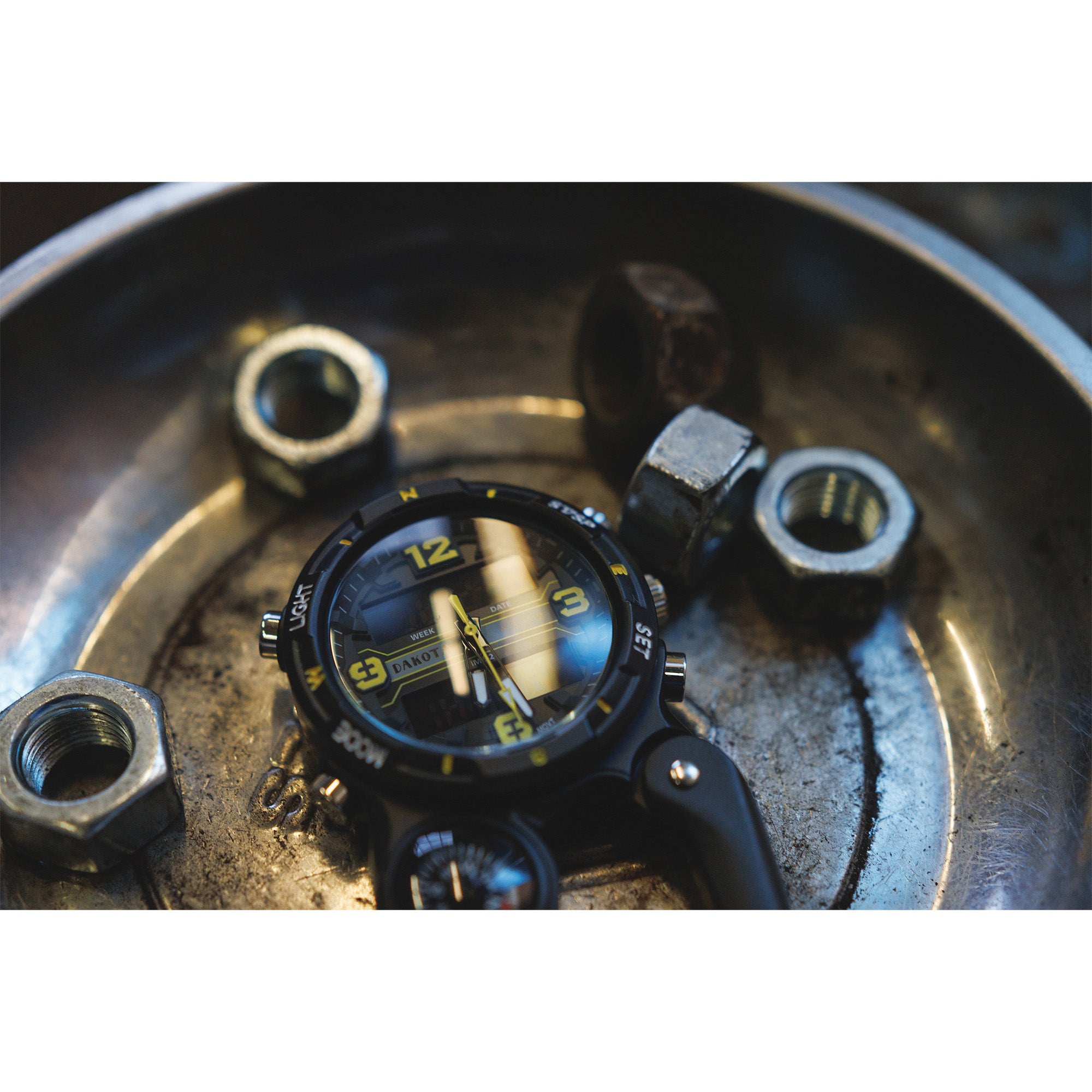
Dakota's zipper-pull designs are particularly well-suited to snowboard gear for sub-zero conditions. They attach securely to jacket pulls, sit flat against the chest when not in use, and can be read without removing gloves or adjusting clothing. The dials are designed for legibility rather than feature density, which aligns with the practical demands of backcountry navigation.
Their cold-resistant analog watch outdoor models typically incorporate the following:
-
Quartz analog movements that maintain accuracy across a wide thermal range
-
Durable casing that resists impact and moisture ingress
-
Matte dials with high-contrast markings for easy reading in flat light conditions
-
Lightweight build suited to zipper-pull attachment without adding bulk
For riders seeking the best watch for avalanche country, Dakota's combination of mechanical simplicity and purpose-built design makes it a practical first choice—particularly for those who don't need GPS or smart features and prioritize reliability over connectivity.
Are there other cold-resistant analog watch outdoor options worth considering?
Dakota is not the only brand in this space. Suunto, Casio's Protrek series, and certain Luminox models are also favored by winter outdoor athletes. However, many of these alternatives prioritize digital features—altitude sensors, barometric pressure tracking, digital compasses—that add battery dependency and screen-related failure points. For pure cold-weather timekeeping with gloves on, a simple analog movement remains the most dependable solution.
Stay Safe, Stay On Schedule in Avalanche Country
Backcountry snowboarding demands respect for the mountain and genuine preparation for what can go wrong. Avalanche training, beacon practice, and route planning get most of the attention—and rightly so. But the small details matter too.
A watch that fails at -20°F isn't a backup plan. A device you can't operate with gloves on isn't usable gear. And a timepiece buried under three layers of insulation might as well stay at home.
The right cold weather watch for snowboarding doesn't need to be expensive or feature-laden. It needs to work every time, in every condition, without requiring bare hands or a functional LCD screen. Analog watches, especially zipper-pull designs from brands like Dakota, check every one of those boxes.
Before your next backcountry session, audit your gear list with one question in mind: will this item still function reliably at -30°F after a hard fall? If the answer is uncertain, it's worth reconsidering. The mountain doesn't offer second chances.
Frequently Asked Questions
Why do digital watches fail in cold weather?
Digital watches rely on LCD screens and battery-powered electronics, both of which degrade significantly at sub-zero temperatures. LCD fluid becomes viscous and unreadable below around -22°F (-30°C), and lithium-ion batteries can lose 40% or more of their capacity in extreme cold. These failures make digital watches unreliable for backcountry snowboarding and other cold-weather sports.
What is a zipper-pull watch, and why is it useful for snowboarders?
A zipper-pull watch is a compact timepiece designed to clip onto a jacket zipper tab, positioning it at chest height for easy viewing. For snowboarders wearing bulky gloves, this eliminates the need to push up sleeves or remove handwear to check the time—a practical safety advantage in cold and windy conditions.
What temperature should a watch for backcountry snowboarding be rated to?
A watch used for backcountry snowboarding should ideally be rated to at least -22°F (-30°C), with greater tolerance being preferable for high-altitude or arctic conditions. Analog movements generally handle cold better than digital electronics.
Are Dakota watches good for sub-zero backcountry conditions?
Dakota produces analog and zipper-pull watch models specifically designed for cold, rugged outdoor use. Their watches are lightweight, glove-readable, and use analog movements that are not subject to LCD failure—making them a solid choice for snowboarders seeking a reliable cold-weather watch.
Is an analog or digital watch better for extreme cold weather sports?
Analog watches are generally more reliable in extreme cold weather sports because they do not depend on LCD screens or high-drain batteries for basic timekeeping. Digital watches offer more features, but those features become liabilities when electronics fail in sub-zero conditions.
What backcountry snowboarding gear essentials are most commonly overlooked?
Beyond the standard avalanche safety kit—beacon, probe, and shovel—backcountry riders often overlook cold-resistant timekeeping. A reliable watch that functions in sub-zero temperatures and can be read with gloves on is a simple but important addition to any winter safety gear setup.