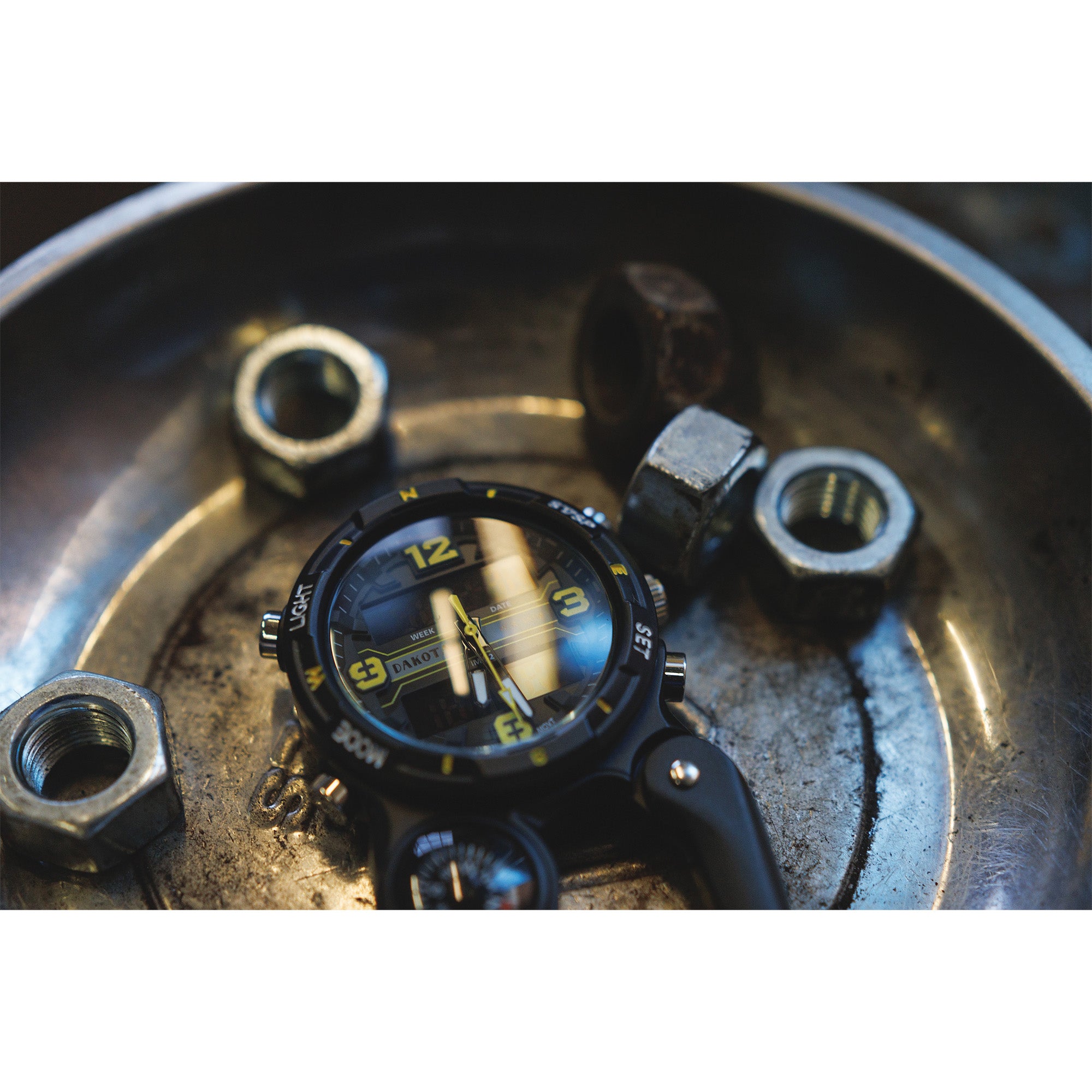

Cave diving gear essentials include redundant illumination, a reliable high-pressure waterproof watch, and backup timekeeping tools for oxygen management. A durable analog watch with a luminous dial, like a Dakota watch built for extreme depth diving, provides critical backup navigation and timing when primary dive computers fail in the absolute darkness of submerged caverns.
Exploring underwater caves demands flawless equipment. There's no natural light, no quick ascent to the surface, and no room for gear that fails under pressure. Every tool a cave diver carries has to perform exactly as expected, every single time, because the environment offers zero margin for error.
This guide breaks down the gear considerations that matter most for cave diving: understanding the darkness you're diving into, choosing the right backup illumination, and building redundancy into your oxygen timing. Whether you're new to technical diving or refining your safety checklist, these are the essentials worth getting right.
What makes cave diving darkness different from open water diving?
Submerged caverns don't just lack sunlight — they often have zero ambient light of any kind. Unlike open water dives, where a diver can usually see the surface shimmer overhead or detect some directional light, cave environments are frequently pitch black beyond the reach of a primary light source.
This absolute darkness changes how divers approach every piece of gear. A dive watch, flashlight, or navigation tool that relies on readability in low light simply won't work. Cave divers need equipment with high-contrast, luminous displays that remain legible even when a primary light source dims, flickers, or fails outright.
This is also why cave diving accessories and safety checklists almost always include multiple independent light sources. A single point of failure in a cave system isn't an inconvenience — it's a life-threatening scenario. Divers who understand this build layers of redundancy into their gear from the very first light to the very last.
Why do cave divers need backup illumination tools like micro-lights?
Primary dive lights are powerful, but they're also mechanical devices, and mechanical devices fail. Battery depletion, seal damage from high-pressure environments, or a simple drop against cave rock can leave a diver without their main light source in an environment with no natural light to fall back on.
This is where backup illumination tools for cave divers earn their place in the gear bag. Micro-lights — small, self-contained light sources — are designed to provide just enough illumination to read instruments, signal a dive partner, or navigate toward a guideline when the primary light goes dark.
A micro-light watch for underwater darkness serves a dual purpose that's particularly valuable in technical diving. It functions as a timekeeping instrument first, but its luminous dial also acts as a secondary light source for reading other gauges or signaling in an emergency. Dakota watches, built for extreme depth diving, are often chosen by technical divers specifically for this dual functionality. A luminous dial watch for submerged caverns means a diver always has a readable light source strapped to their wrist, independent of battery-powered primary lights.
When evaluating backup illumination, divers should prioritize:
-
Independence from primary power sources. Backup lights shouldn't share a battery system or charging cycle with primary equipment.
-
Durability under high pressure. Any high-pressure waterproof watch or light tool needs a depth rating that comfortably exceeds the planned dive depth.
-
Readability without external light. Luminous or self-illuminating dials should be legible at a glance, with no need to angle toward a light source.
Why is redundant timekeeping critical for oxygen management?
Oxygen management is arguably the single most important calculation a cave diver makes, and it's entirely dependent on accurate time tracking. Divers plan their air supply, decompression stops, and turnaround points around elapsed time. If a dive computer malfunctions or a primary timing device fails mid-dive, a diver without a backup has no reliable way to know how much breathable air remains or when it's time to start heading back.
This is why redundant timekeeping for oxygen management isn't an optional add-on for technical divers — it's considered a core part of cave diving gear essentials for beginners and veterans alike. An oxygen timing watch for deep-water diving acts as a failsafe, running independently of any dive computer or electronic gauge. If the primary system fails, the diver still has an accurate, analog reference point for how long they've been underwater and how much time remains before they need to surface or begin a controlled ascent.
A durable watch for extreme underwater conditions should meet a few specific criteria for this role:
-
Mechanical or battery independence from dive computers. The watch should never share a failure point with the primary dive computer.
-
Accurate elapsed-time tracking. A rotating bezel or stopwatch function allows divers to mark dive start times and track elapsed minutes at a glance.
-
Pressure resistance well beyond planned dive depth. A best watch for technical cave diving should be rated for pressures far exceeding the cave system's maximum depth, leaving a margin for error.
-
Analog reliability. An analog watch for underwater navigation doesn't need batteries to display accurate information, which makes it a dependable backup when electronics fail.
Choose a redundant timekeeping tool with a straightforward bezel and stopwatch function if simplicity and reliability matter more than advanced features. Divers who want additional data — like depth tracking or temperature — may lean toward a dive computer as a primary tool, but a dedicated analog watch for underwater navigation should still serve as the non-negotiable backup.
What should go on a cave diving safety checklist?
Beyond illumination and timekeeping, underwater cave exploration safety gear should always include:
-
A primary and backup light source, fully charged and tested before the dive.
-
A reliable guideline reel for navigation back to the cave entrance.
-
A high-pressure waterproof watch rated well beyond the planned dive depth.
-
A redundant air supply, separate from the primary tank.
-
A dive plan shared with a surface contact or dive buddy, including planned turnaround times.
Every item on this list exists because something could fail, and cave environments don't forgive equipment gaps the way open water dives sometimes do.
Never compromise on safety in extreme depths.
Cave diving rewards preparation and punishes shortcuts. The absolute darkness, the pressure, and the complete absence of a quick way to the surface mean every piece of gear has to be chosen with redundancy and durability in mind, not just performance in ideal conditions.
A luminous dial watch for submerged caverns, a dependable micro-light, and a layered approach to oxygen timing aren't just extra weight on a gear belt. They're the tools that stand between a well-managed dive and a dangerous situation. Before the next dive, run through the full safety checklist, test every backup system, and make sure timekeeping redundancy is built in from the start. In cave diving, the gear that never gets used is often the gear that matters most.
Frequently Asked Questions
What cave diving gear essentials should beginners prioritize first?
Beginners should prioritize a primary and backup light source, a reliable guideline reel, and a redundant timekeeping tool such as a durable analog watch. These three categories address the most common failure points in cave environments: lost illumination, lost navigation, and inaccurate oxygen timing.
What makes a watch suitable for cave diving?
A watch suitable for cave diving needs a high-pressure rating that exceeds planned dive depth, a luminous dial readable without external light, and reliable elapsed-time tracking through a bezel or stopwatch function. Analog designs are often preferred as backups since they don't depend on battery power the way dive computers do.
Why do cave divers need backup timekeeping instead of relying on a dive computer?
Dive computers can fail due to battery depletion, electronic malfunction, or seal damage under pressure. A backup analog watch provides an independent, mechanically reliable way to track elapsed dive time, which is essential for calculating remaining oxygen supply and decompression timing.
Are micro-light watches a replacement for primary dive lights?
No. Micro-light watches are designed as backup illumination, not primary light sources. Their main function is timekeeping, with the luminous dial serving as a secondary light for reading instruments or signaling in an emergency if the primary light fails.
What depth rating should a cave diving watch have?
A cave diving watch should have a depth rating that comfortably exceeds the maximum depth planned for the dive, leaving a safety margin. This ensures the watch continues functioning reliably even if the dive goes deeper or longer than anticipated.